Most maple syrup labels do not tell you what is actually different between organic and conventional production. Here are the four real distinctions, and why they matter.
Most shoppers comparing organic and conventional maple syrup end up reading marketing copy rather than the actual production differences. The bottle on the shelf rarely explains what changes when a producer decides to certify a sugarbush organic, and most articles online repeat generic claims about "no chemicals" without naming what is actually prohibited and what is allowed.
The honest list is short. Producers and certifiers track four real differences between organic and conventional maple syrup production: synthetic chemical defoamers used during boiling, the size of the tap holes drilled into the trees, the required mix of tree species in the woodlot, and whether the operation is audited by an independent third party. Everything else (taste, nutrition, sugar content, colour) sits within the same range for both.
This guide walks through each of the four real differences, then takes an honest look at price, taste, and nutrition, so you can answer the real question for yourself: is organic maple syrup better, and better for what you actually care about? The short version: a buyer who values verified production methods and forest stewardship gains the most from choosing organic, because organic and conventional pure maple syrup otherwise sit within the same range for taste, colour, and nutrition. The differences that matter sit in the boiling room and the forest, and the four sections below name each one.
When sap boils down into syrup, it foams. The foam interferes with evaporation, scorches against the pan walls, and can ruin a batch if it builds up uncontrolled. Producers add a small amount of defoamer to break the foam back down.
Conventional producers are permitted to use synthetic chemical defoamers. The most common one historically was a petroleum-derived compound, though most operations have moved to food-grade synthetic alternatives. Either way, the synthetic option is allowed under conventional standards.
Organic producers are prohibited from using any synthetic defoamer, because the National Organic Program permits only the processing aids cleared on its National List (USDA National Organic Program, 2026). The approved options for an organic operation are limited to organic vegetable oil or organic animal fats (typically a small amount of organic butter or organic sunflower oil). The volumes involved are tiny in both cases, but the substance going into the syrup is materially different.
The practical implication: an organic-certified syrup carries documentation that no synthetic processing aid touched the product during boiling. A conventional syrup carries no such guarantee. For a buyer who cares about how the food was made, that documentation is the point.
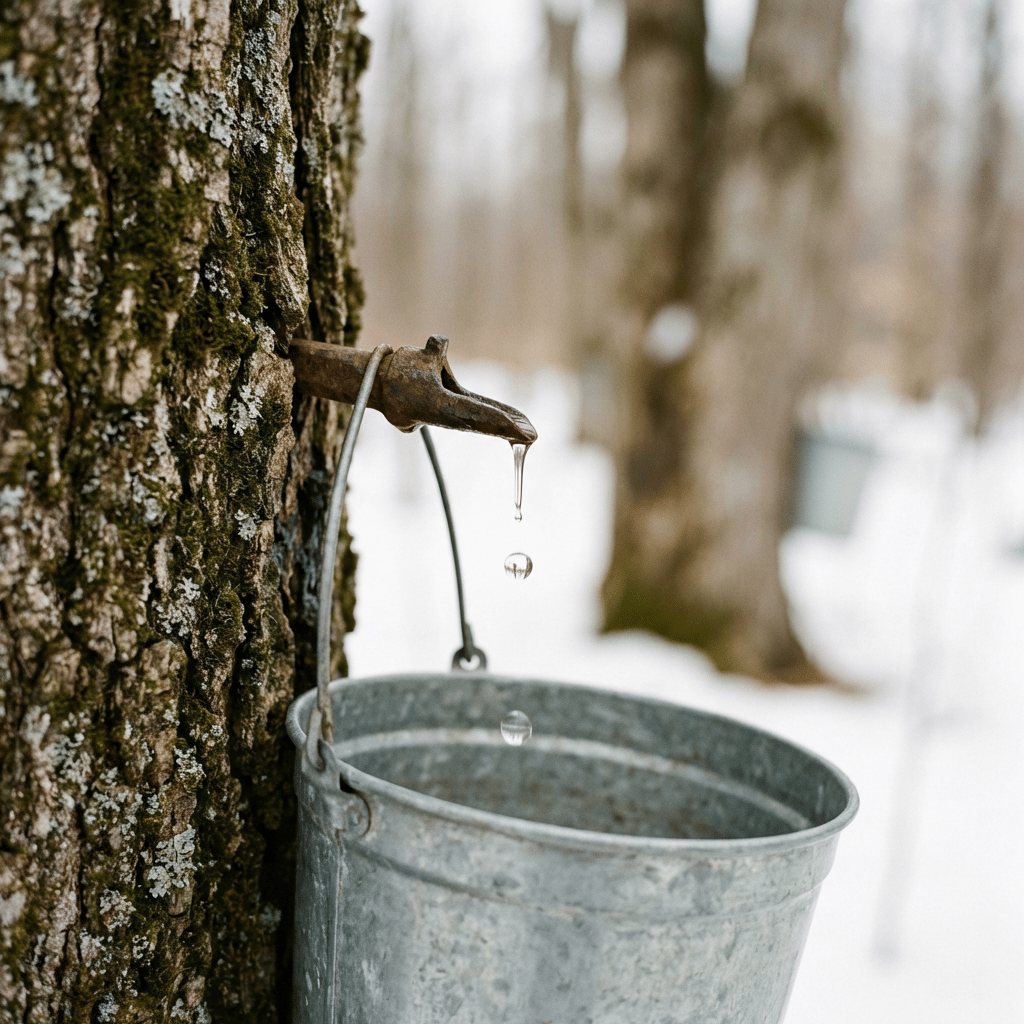
A producer draws sap by drilling a small hole into a maple tree and inserting a metal or plastic spout (called a spile). The tree heals the hole over the following year as new wood forms around the wound.
Organic certification requires producers to use smaller 5/16 inch tap holes and limits how many taps a tree can carry, both to protect long-term tree health (Vermont Organic Farmers, 2026). The hole is small enough that a healthy tree closes it within one growing season and the surrounding wood shows minimal lasting damage. Conventional production allows tap holes up to 7/16 inch, which is roughly 40 percent wider in diameter and takes substantially longer to heal. Larger holes also create larger zones of compromised wood that the tree must seal off, which can affect sap yield in later years.
Over the lifetime of a sugarbush (a maple stand can produce sap for 100 years or more), the cumulative effect of tap hole size matters. Smaller holes mean healthier trees, less internal scarring, and a more productive forest decades later. Organic producers accept the slightly lower per-tap sap yield in exchange for long-term tree health.
This is one of the production differences that has a measurable impact on the forest itself, not just the syrup in the bottle.
Organic certification requires that a maple woodlot keep a minimum share of companion species, meaning trees other than sugar maple (Vermont Organic Farmers, 2026). The list of acceptable companions includes yellow birch, American beech, eastern hemlock, basswood, white ash, and red maple, among others.
Conventional production has no biodiversity requirement. A conventional sugarbush can be a near-monoculture of sugar maple, which maximizes sap yield per acre in the short term. The trade-off is that monoculture forests are more vulnerable to disease, pest outbreaks, and climate stress. When a pathogen targets sugar maple specifically (and several do, including Asian longhorned beetle and sugar maple borer), a monoculture sugarbush can lose its entire harvestable stand. A forest carrying a healthy mix of companion species absorbs the shock differently.
The companion-species rule also supports the broader forest ecosystem. Different tree species host different insects, fungi, and birds. A maple-only stand carries less of that complexity than a mixed Appalachian forest.
For a buyer evaluating organic versus conventional, this is the difference that affects forest land over decades. The bottle is the same size; the forest behind it is structured differently.
Organic production must be verified annually by an accredited, independent certifying body, with an on-site inspection each year (USDA, 2026). The certifier audits the woodlot, the boiling equipment, the defoamers on hand, the tap inventory, the storage facility, and the records that document every batch. The audit is a real document that the certifier signs off on, and the certification can be revoked if the producer fails to meet standards in any year.
Conventional production has no certification requirement. A producer can label syrup as "pure maple syrup" or "100 percent maple syrup" without any third party verifying production methods. The pure-maple-syrup label is regulated for the contents of the bottle (no additives, no dilution), but not for the process behind it.
The three certifications worth looking for on a maple syrup bottle:
Ecocert. An international certifying body founded in France in 1991, recognized across Europe, North America, and Asia. Ecocert audits cover both production methods and supply-chain integrity, and its standards are accepted by retailers and importers worldwide. A bottle carrying the Ecocert seal has passed an annual audit by one of the strictest international certifiers.
Canada Organic. The Canadian government's official organic standard, administered by the Canadian Food Inspection Agency. Any product sold as "organic" in interprovincial Canadian commerce must meet this standard. The Canada Organic logo on a bottle of maple syrup means the operation meets federal Canadian requirements verified by an accredited Canadian certifier.
USDA Organic. The United States government's official organic standard, administered by the National Organic Program. Any product sold as "organic" in the US must meet this standard. The USDA Organic seal on a bottle confirms the operation has been audited against US federal rules by an accredited US certifier.
A producer who holds all three has been independently audited by three separate bodies on an annual basis. The redundancy matters because the standards differ in detail, and a bottle that passes all three meets the strictest interpretation of each.
Organic maple syrup typically costs 10 to 30 percent more than conventional, depending on the producer, the region, and the retailer. The premium reflects three real cost drivers.
First, the production process is more labour-intensive. Smaller tap holes yield less sap per tap, so an organic producer needs to tap more trees to reach the same volume. Maintaining the companion-species requirement also reduces the maximum density of sugar maple per acre. Both lower the operational efficiency that a pure conventional sugarbush can hit.
Second, the certifying bodies charge for the annual audit. Ecocert, Canada Organic, and USDA Organic each carry their own fee structure, and a producer holding multiple certifications pays each one. Those fees pass through into the bottle price.
Third, the bookkeeping is heavier. Organic certification requires that a producer document every input, every batch, every defoamer use, and every tap inventory change. That recordkeeping takes administrative hours that a conventional producer does not have to spend.
Whether the premium is worth it depends on what the buyer values. A buyer who cares about the four real differences above sees the 10 to 30 percent premium as a reasonable price for verified production methods. A buyer who only cares about flavour and price often does not see the value, because the in-the-mouth difference is small.
Most articles on this topic exaggerate the nutritional and taste differences between organic and conventional maple syrup. The honest read is that both differences are small.
On nutrition, the two are roughly identical, because both are simply maple sap reduced to syrup. Both contain the same natural sugars (predominantly sucrose with smaller amounts of glucose and fructose), the same trace minerals (manganese, zinc, calcium, potassium), and the same modest antioxidant profile. A teaspoon of organic syrup and a teaspoon of conventional syrup deliver the same calories and the same nutrient load. The organic certificate changes how the syrup was made, not what ends up in the bottle.
On taste, the differences sit inside the range that two conventional syrups from different farms can show. Quebec's organic and conventional producers both grade syrup against the same colour and flavour classification (Golden, Amber, Dark, Very Dark). Grade, harvest week, and the individual farm shape flavour far more than the organic label does, which is why a buyer reaching for a specific flavour should choose by grade rather than by certification.
The real differences between organic and conventional maple syrup are environmental and trust-based, not nutritional or sensory. A buyer choosing organic primarily for taste or for a health benefit on a per-calorie basis is likely paying for something the bottle does not deliver. A buyer choosing organic for the production method, the tree health, the forest composition, and the third-party verification is paying for exactly what the certification provides.
Maple Terroir holds all three of the organic certifications named above: Ecocert, Canada Organic, and USDA Organic. Our team is the only Canadian maple syrup line that holds all three simultaneously. The redundancy is deliberate. Each certifier inspects on a different cycle, and any one of them can flag a problem that the others might miss. Holding all three gives a buyer three independent layers of verification on every bottle.
Our sugarbush sits in Quebec's Appalachian Mountains, the same region that produces most of the world supply of single-origin maple syrup. We use 5/16 inch organic-spec taps. Our woodlot exceeds the companion-species minimum by a wide margin, with substantial yellow birch, American beech, and eastern hemlock alongside the sugar maple. Our boiling operation uses only organic vegetable-based defoamers.
The full audit details for each of our certifications, including the certifier names and the renewal cycles, are documented on our certifications page. For the difference between syrup grades, see our guide on Grade A vs Grade B maple syrup, and for the line between the real thing and imitation, see pure maple syrup vs table syrup. To see how maple compares with another natural sweetener, read maple syrup vs honey.
Not reliably. Grade and harvest week drive maple flavour far more than the organic label does, so two syrups of the same grade taste close to identical whether or not one carries certification. The flavour difference, if any, sits inside the variation you would see between two farms in different parts of Quebec.
Not true. Maple trees themselves are not sprayed in either organic or conventional production. The real differences are upstream of the trees (forest composition) and inside the boiling room (defoamers and equipment). Anyone explaining the organic difference as "no pesticides on the maple trees" is repeating a generic organic claim that does not apply to how maple syrup is actually made.
Not true. Multiple bodies certify organic maple production, and not all hold producers to the same level of detail. A bottle carrying Ecocert plus Canada Organic plus USDA Organic together is the strongest signal a buyer can look for, because the producer has cleared three separate annual audits against three separate rule sets. A bottle carrying only one certification meets that one standard but no others.
Maple Terroir is the only Canadian maple syrup line that holds Ecocert, Canada Organic, and USDA Organic certifications simultaneously.
Better at what? On environmental impact (synthetic defoamers, tree health, forest biodiversity), yes, organic is materially better. On taste and nutrition, the difference is minimal, because both are pure maple sap reduced to syrup. The honest answer depends on what you value. A buyer who cares about how the syrup is produced should choose organic. A buyer who only cares about taste and price often does not see a meaningful difference.
Producers and certifiers track four real differences. First, synthetic chemical defoamers are allowed in conventional production and prohibited in organic. Second, organic producers must use smaller tap holes (5/16 inch) that heal faster on the trees, while conventional production can use holes up to 7/16 inch. Third, organic woodlots must keep a required share of companion (non-maple) tree species to support forest biodiversity. Fourth, organic production is verified annually by third-party certifiers like Ecocert, Canada Organic, and USDA Organic. Conventional production has no such certification requirement.
Organic maple syrup typically costs 10 to 30 percent more than conventional. Whether the premium is worth it depends on whether the buyer values environmental practices, tree health, and third-party verification of how the syrup was made. For buyers who value those things, yes. For buyers who do not, the difference in the bottle on a Sunday morning is minimal.
Minimally. The nutritional content of organic and conventional maple syrup is roughly identical. Both contain the same natural sugars, minerals, and trace antioxidants. The benefits of organic maple syrup are environmental and trust-based rather than nutritional. The cleaner production process matters for forest health and for the absence of synthetic processing aids, not for the calorie or vitamin profile.
Three certifications carry real weight on a maple syrup label. Ecocert is an international certifier with audit standards recognized across Europe and North America. Canada Organic is the Canadian government standard required for any product labeled organic in Canada. USDA Organic is the United States government standard required for any product sold as organic in the US. A producer who holds all three has been independently audited by three separate bodies on an annual cycle. Maple Terroir is the only Canadian maple syrup line holding all three.