
Unopened, pure maple syrup keeps for years. Once you open the bottle, it belongs in the fridge. Here is the honest guide to shelf life, storage, mold, and the crystals at the bottom of the jar.
The short answer: pure maple syrup does not really go bad, but it can grow mold once the bottle is open. An unopened bottle kept somewhere cool and dark stays good for years. The moment you break the seal, the rules change, and the bottle needs the refrigerator.
The reason sits in the syrup itself. Pure maple syrup is roughly two-thirds sugar, with very little free water left for mold or bacteria to use. That high sugar concentration is what lets an unopened bottle last so long. Open the bottle and you let in air and a little moisture, and over enough time, surface mold can form.
This guide covers how long maple syrup lasts in each situation, exactly where to store it, what to do if you find mold or crystals, and the storage choices Maple Terroir makes so a bottle reaches you in the best possible shape. Everything below draws on food-safety guidance from university extension programs that study maple syrup directly.
Pure maple syrup does not spoil the way milk or bread does. It is one of the most stable foods in the kitchen, because it is roughly two-thirds sugar and holds very little free water. Mold and bacteria need available water to grow, and a sealed bottle of pure maple syrup gives them almost none.
That stability has limits, and the limit is the seal. An unopened bottle stored cool and dark keeps its flavour and stays safe for years. Once you open it, air and a small amount of moisture reach the surface, and over weeks and months, mold can appear on top. This is why the University of Maine Cooperative Extension advises moving syrup to the refrigerator after opening (University of Maine Cooperative Extension, 2026).
So the honest framing is this. Pure maple syrup does not go bad on its own, the way a perishable food does. It goes bad only when an opened bottle sits warm long enough for surface mold to take hold. Keep the bottle sealed until you need it, then keep it cold once it is open, and the syrup outlasts almost everything else on the shelf.
Shelf life depends on two things: whether the bottle is open, and what the bottle is made of. University extension guidance lines up closely on the ranges below (University of Maine Cooperative Extension, 2026; Michigan State University Extension, 2026).
Two details explain the gaps. Glass and tin hold flavour longer than plastic, because plastic lets in a small amount of air that slowly shifts the colour and taste. And the freezer wins for long-term storage because pure maple syrup is so high in sugar that it never freezes solid, so the flavour holds without the syrup turning into a block.
Maple syrup has three natural homes, and the right one depends on whether you have opened the bottle and how soon you plan to finish it.
Keep the sealed bottle somewhere cool, dark, and dry. A cupboard away from the stove is ideal. No fridge needed until you open it.
Once the seal is broken, the refrigerator is the right home. Cold storage slows or prevents the surface mold that opened syrup can grow at room temperature.
For a bottle you will not finish soon, the freezer holds flavour indefinitely. The syrup stays pourable and needs about an hour at room temperature to loosen fully.
A few practical notes round this out. Always pour from a clean, dry spoon or pour straight from the bottle, because crumbs and butter introduced into the syrup give mold something to feed on. Keep the cap clean and closed between uses. And if you buy in bulk, store the large container in the freezer and keep a smaller working bottle in the fridge, so you only thaw what you need.
This is where a lot of kitchen advice gets it wrong, so it is worth being precise. A common tip says that if mold forms on maple syrup, you can scrape it off, boil the syrup, and keep using it. Food-safety researchers who study maple syrup do not agree with that tip.
Michigan State University Extension is direct about it: mold can leave behind mycotoxins, and those mycotoxins can survive the boiling process, so removing the visible mold and reboiling does not make the syrup safe (Michigan State University Extension, 2026). The mold you can see is the warning sign. The part you cannot see is the reason to let the bottle go.
So the safe rule is simple. If mold has formed on a bottle of maple syrup, discard the syrup rather than salvage it. The good news is that this almost never happens to syrup that is handled correctly, because refrigerating an opened bottle slows or prevents mold from forming in the first place. Prevention is the whole game here, and prevention is just the fridge.
Sugar crystals at the bottom of the bottle worry a lot of people, and they should not. Crystals are not mold, not spoilage, and not a sign the syrup has turned. They are pure sugar dropping out of solution.
Crystals form when a little water evaporates over time and the syrup becomes more concentrated than it can hold, which is common near the end of a bottle or after a long stretch in storage. The sugar simply separates back out as crystals. The syrup is still perfectly good.
To fix it, warm the syrup gently and stir. You can stand the bottle in a bowl of hot water, warm the syrup in a saucepan over low heat, or use short bursts in the microwave, stirring between each one until the crystals dissolve back in. Avoid a hard boil, which can darken the flavour. Once the crystals are gone, the syrup pours and tastes exactly as it should.
Storage starts at the source, with the bottle we choose. Maple Terroir bottles its pure maple syrup in glass, the container that holds colour and flavour the longest once a customer opens it. A bottle that travels well and stores well is part of the product, not an afterthought.
What goes into the bottle matters just as much for how long it keeps. Our syrup is single-origin, drawn from one family sugarbush in Quebec's Appalachian Mountains, then graded and filled as pure maple syrup with nothing added. There is no diluting water and no additive to shorten its life, which is exactly why a sealed bottle lasts for years. You can read the full process in our complete guide to Canadian maple syrup.
Maple Terroir is the only Canadian maple syrup line that holds Ecocert, Canada Organic, and USDA Organic on its syrup at the same time, which means the bottle on your counter has been audited for purity by three separate bodies. To choose the grade and flavour that suits you, see our guide to Grade A vs Grade B maple syrup, and to tell the real thing from imitation, see pure maple syrup vs table syrup. When you are ready to stock up, our pure maple syrup collection and our organic maple syrup are the place to start.
Half true. A sealed bottle lasts for years, but an opened bottle left at room temperature can grow surface mold. The seal is the dividing line. Once it is broken, the bottle needs the refrigerator.
Not safe. Mold can leave mycotoxins that survive boiling, so removing the visible layer does not make the syrup safe again. If mold has formed, the safe choice is to discard the bottle and rely on refrigeration to prevent it next time.
Not true. Crystals are pure sugar separating out as a little water evaporates, which is harmless. Warm the syrup gently and stir until they dissolve, and the bottle is good as new.
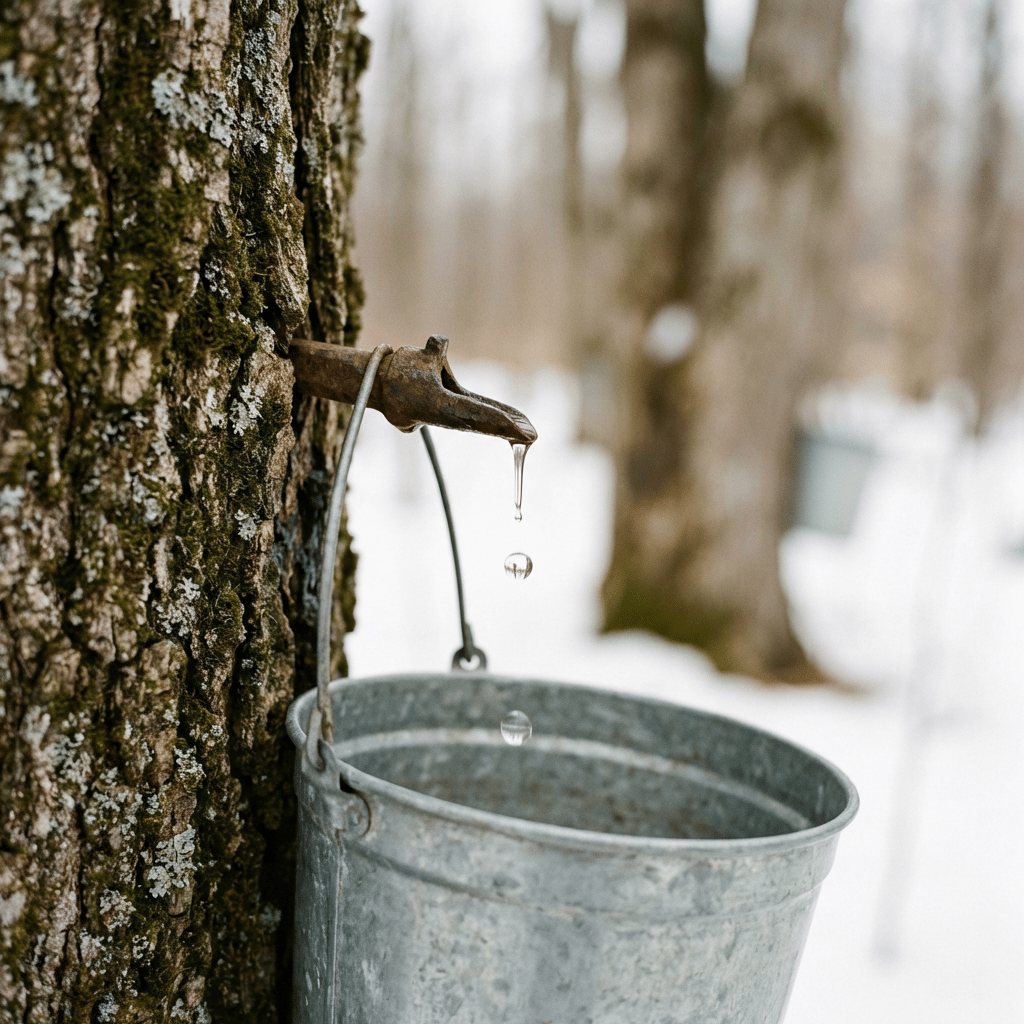
Single-origin, bottled in glass, and certified by Ecocert, Canada Organic, and USDA Organic. Stored well, a bottle of Maple Terroir lasts a long time.
Pure maple syrup does not spoil the way fresh food does, because it is roughly two-thirds sugar and holds very little free water for microbes to use. An unopened bottle kept cool and dark stays good for years. Once a bottle is opened, mold can grow on the surface over time, so opened syrup belongs in the refrigerator. Stored that way, pure maple syrup keeps its flavour and stays safe far longer than most pantry foods.
Yes. Once a bottle is opened, the University of Maine Cooperative Extension and Michigan State University Extension both advise refrigerating pure maple syrup to slow or prevent surface mold. An opened bottle left in the pantry will eventually grow mold. Cold storage keeps the syrup safe and protects its flavour.
Opened pure maple syrup in a glass or tin container keeps for about one year in the refrigerator. Syrup in a plastic container is best used within three to six months, because plastic lets in a small amount of air that changes the colour and flavour over time. For longer storage, the freezer keeps maple syrup indefinitely.
Yes, and the freezer is the best option for long-term storage. Because pure maple syrup is so high in sugar, it does not freeze solid. It thickens into a pourable syrup that needs about an hour at room temperature to return to normal consistency. Freezing holds the flavour and quality for an indefinite period.
No. The common advice to scrape the mold and reboil the syrup is not the safe choice. Michigan State University Extension notes that mold can leave behind mycotoxins that survive the boiling process, so removing the visible mold does not make the syrup safe. If mold has formed, the safe step is to discard the syrup. Refrigerating opened syrup prevents the problem in the first place.
Crystals at the bottom of the bottle are sugar, not spoilage. They form when some water evaporates and the syrup becomes more concentrated than it can hold, which is common near the end of a bottle or after long storage. To fix it, stand the bottle in a bowl of warm water, or warm the syrup gently on the stove or in short bursts in the microwave, and stir until the crystals dissolve. The syrup is perfectly good to use.